
QR Code

About Us
Products
Contact Us

Phone

Fax
0086-574-87527773

Email

Address
No 432 Zhenhai Middle Road, Luotuo Street, Zhenhai District, Ningbo City, Zhejiang China


What Industries Commonly Use Die Formed Graphite Rings? For maintenance engineers and procurement teams, this question usually appears at the worst possible moment: a pump is leaking, a compressor is losing efficiency, or a high-temperature process is drifting out of control. The answer matters because die formed graphite rings are not a generic commodity. They are precision sealing components made by pressing high-purity graphite powder into dense rings, then machining them to tolerances that fit shafts, housings, and mechanical seals. Buyers see them in chemical plants, semiconductor fabs, metallurgy lines, oil and gas facilities, power generation, and thermal processing equipment. In each setting, the ring must balance temperature resistance, chemical compatibility, mechanical strength, and dimensional stability. Ningbo Kaxite Sealing Materials Co., Ltd. works with procurement and engineering teams to match die formed graphite rings to the actual operating window, not just a catalog number. That means clarifying media, pressure, temperature, shaft speed, and installation space before production. The result is fewer emergency replacements, more predictable lead times, and sealing performance that holds up during thermal cycling and continuous duty.
Pain point: Procurement teams often receive a request for “a graphite ring” with only a drawing and a temperature. That thin brief invites mismatches: a ring that works in a dry compressor may fail in a chemical pump with solvent carryover, and a grade that survives high heat may shed particles in an electronics tool. The cost is not just the ring. It is the unplanned shutdown, the rework, and the expedited freight that follows.
Solution: Start with the application, not the part number. Ningbo Kaxite Sealing Materials Co., Ltd. reviews the medium, pressure, temperature, shaft speed, and mating surface before recommending a Die Formed Graphite Ring grade. This approach helps buyers compare density, purity, machining tolerance, and impregnation options in one conversation, so the seal matches the duty instead of merely fitting the space.
| Industry | Typical Equipment | Key Demand | Kaxite Focus |
|---|---|---|---|
| Chemical processing | Pumps, reactors, valves | Corrosion resistance and leak control | Media compatibility review |
| Thermal processing | Furnaces, heat exchangers | Thermal cycling stability | Density and purity control |
| Semiconductor | Vacuum and process tools | Low particle generation | Clean machining and traceability |
| Metallurgy | Fans, pumps, furnace seals | Heat and load resistance | Grade selection for harsh duty |
| Oil, gas, and power | Compressors, turbines, pumps | Continuous-duty reliability | Batch consistency and delivery planning |
Pain point: A small leak in a chemical pump can become a safety review, a cleanup, and a production delay in the same shift. Aggressive acids, solvents, and caustic fluids attack the wrong seal material quickly, while temperature swings change clearances and loading. Buyers need a ring that resists the medium and keeps a stable face load without becoming brittle or dimensionally loose.
Solution: Die formed graphite rings are often selected for chemical processing because they combine thermal stability with low friction and good mechanical strength. The practical work is in the details: confirm the concentration, temperature, pressure, and presence of solids; then choose the appropriate graphite grade and impregnation route. Ningbo Kaxite Sealing Materials Co., Ltd. supports this review with application questions and sample evaluation, helping buyers avoid a trial-and-error cycle that costs more than the component itself.
| Parameter | Typical Planning Range | Why the Buyer Should Confirm |
|---|---|---|
| Medium | Acids, solvents, caustics, water | Drives grade and impregnation choice |
| Temperature | Ambient to high-temperature service | Affects oxidation risk and clearance |
| Pressure | Low to medium sealing loads | Sets ring strength and face loading needs |
| Solids in media | Clean to mildly contaminated | Influences wear and surface finish |
Pain point: Heat cycling exposes weak sealing choices. A ring may fit perfectly at room temperature, then lose face contact when the housing expands, or oxidize when the process runs hotter than expected. Maintenance teams see the symptom as leakage, torque drift, or frequent replacement, but the root cause is often a grade that was never matched to the thermal profile.
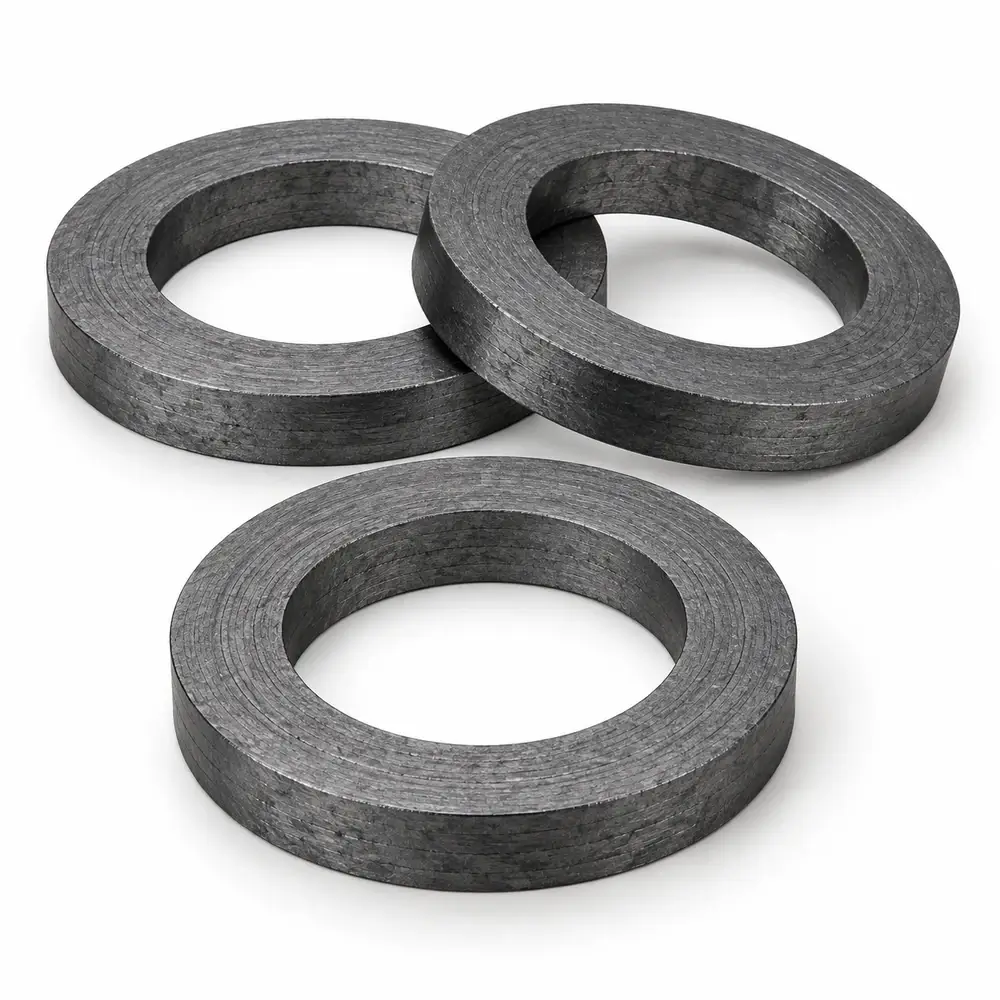
Solution: A die formed graphite ring with controlled density and high purity can maintain dimensional stability through repeated heating and cooling. The buyer should share the maximum temperature, cycle frequency, atmosphere, and mating material. Ningbo Kaxite Sealing Materials Co., Ltd. uses these inputs to recommend ring density, machining tolerance, and handling guidance that reduce the chance of breakage during installation and early wear during service.
| Parameter | Typical Planning Range | Why the Buyer Should Confirm |
|---|---|---|
| Density | Medium to high density grades | Balances strength, porosity, and conformability |
| Purity | High-purity graphite options | Reduces oxidation and contamination risk |
| Atmosphere | Air, inert gas, vacuum, steam | Changes material behavior at temperature |
| Cycle profile | Continuous or frequent cycling | Affects clearance and installation design |
Pain point: In semiconductor and electronics manufacturing, a seal that works mechanically can still create a process problem. Fine particles, outgassing, or inconsistent surface quality can contaminate a chamber, disturb vacuum performance, or trigger extra cleaning. Buyers are asked to prove that the component is clean, traceable, and repeatable lot after lot.
Solution: High-purity die formed graphite rings can support demanding process equipment when the machining and handling are controlled. The conversation should cover allowable particle levels, cleaning methods, packaging, and dimensional inspection. Ningbo Kaxite Sealing Materials Co., Ltd. helps buyers translate process requirements into practical specifications, so the purchased ring is not only the right shape but also the right cleanliness level for the tool.
| Checkpoint | Typical Requirement | Procurement Benefit |
|---|---|---|
| Material purity | High-purity graphite grade | Lower contamination risk |
| Surface finish | Controlled machining finish | Better sealing and fewer particles |
| Dimensional tolerance | Drawing-specific tolerance | Repeatable installation fit |
| Packaging | Clean, protected, labeled | Reduces handling damage |
Pain point: Metallurgy and foundry equipment rarely offers gentle conditions. Heat, dust, vibration, and heavy duty cycles punish seals that lack mechanical strength. A ring that chips during installation or wears too quickly creates unplanned maintenance, and in a foundry the cost of stopping a line can dwarf the component price.
Solution: Die formed graphite rings are used in furnace equipment, fans, pumps, and related sealing positions because they tolerate high temperature and provide stable friction behavior. Buyers should confirm load, vibration, dust exposure, and maintenance intervals. Ningbo Kaxite Sealing Materials Co., Ltd. can review the drawing and duty cycle to recommend a grade that balances strength with installation handling, helping maintenance teams reduce breakage and extend replacement intervals.
| Parameter | Typical Planning Range | Why the Buyer Should Confirm |
|---|---|---|
| Compressive strength | Medium to high strength grade | Helps resist load and handling damage |
| Temperature | High-temperature furnace duty | Sets material and clearance limits |
| Dust exposure | Clean to dusty environments | Influences wear and maintenance planning |
| Vibration | Low to moderate vibration | Affects ring support and face stability |
Pain point: Continuous-duty equipment in oil, gas, and power generation leaves little room for sealing surprises. A compressor or turbine seal that wears early can force a shutdown window, and procurement teams need confidence that the replacement ring will match the original fit and perform through long operating hours. Pressure, vibration, and temperature are rarely constant, which makes material consistency critical.
Solution: Die formed graphite rings can offer stable friction, heat resistance, and dimensional accuracy for demanding rotating equipment. The buyer should confirm shaft speed, pressure profile, lubrication, and shutdown frequency. Ningbo Kaxite Sealing Materials Co., Ltd. supports procurement planning with specification review, batch consistency checks, and delivery coordination so maintenance teams receive components that fit the planned outage, not an emergency order that creates new delays.
| Parameter | Typical Planning Range | Why the Buyer Should Confirm |
|---|---|---|
| Shaft speed | Low to high-speed rotating equipment | Affects friction and face design |
| Pressure profile | Steady or fluctuating pressure | Sets strength and support requirements |
| Lubrication | Dry, oil, or process-lubricated | Changes wear behavior and grade choice |
| Outage schedule | Planned or emergency maintenance | Drives lead-time and packaging needs |
The most common buyers are in chemical processing, thermal management, semiconductor equipment, metallurgy, oil and gas, power generation, and general industrial maintenance. They use these rings in pumps, compressors, valves, furnaces, heat exchangers, and mechanical seal assemblies where heat resistance and stable friction are important.
Sometimes, but not always. A grade that performs well in a dry high-temperature application may not be ideal for a chemical pump with solvent exposure. Buyers should compare purity, density, strength, and impregnation needs against the actual medium and duty cycle before approving a cross-industry substitution.
Kaxite reviews the application conditions with the buyer and recommends a die formed graphite ring specification that fits the equipment. That support helps purchasing teams compare options without guessing which grade will survive the process.
| Buyer Question | Practical Answer | Kaxite Support |
|---|---|---|
| Is this ring for a pump or compressor? | Equipment type changes loading and speed needs | Application review before quotation |
| Is the medium corrosive? | Chemical compatibility drives grade choice | Media and temperature checklist |
| Will the ring see heat cycling? | Cycle profile affects stability and clearance | Density and tolerance guidance |
Confirm the drawing dimensions, graphite grade, density, purity, surface finish, impregnation if required, quantity, packaging, and inspection method. For rotating equipment, also confirm shaft speed, pressure, temperature, and medium. A complete request reduces the risk of a quotation that looks correct but misses a critical operating condition.
Ask for dimensional reports, material declarations, and batch traceability that match the purchase order. For repeat orders, keep an approved sample and inspection plan. Ningbo Kaxite Sealing Materials Co., Ltd. supports buyers with practical inspection information and consistent production controls so the approved specification stays stable across shipments.
Share the maintenance schedule early and separate standard sizes from drawing-based parts. Custom die formed graphite rings need time for drawing review, machining, and inspection. Early confirmation of quantity and delivery location helps avoid expedited freight and last-minute production pressure.
| Procurement Check | What to Confirm | Why It Matters |
|---|---|---|
| Drawing | Dimensions and tolerances | Prevents fit and installation issues |
| Material | Grade, density, purity | Matches process and service life |
| Inspection | Reports and traceability | Supports incoming quality control |
| Schedule | Quantity and delivery date | Avoids outage delays |
When a sealing problem is costing production time, bring the operating conditions to Ningbo Kaxite Sealing Materials Co., Ltd. The company manufactures and supplies die formed graphite rings, graphite packings, PTFE packings, and sealing components for industrial buyers who need stable quality, practical engineering support, and responsive delivery. Share your medium, temperature, pressure, speed, and drawing with the team at https://www.graphite-ptfe-packing.com or email [email protected] to discuss a specification that fits your equipment and your schedule.
Zhao, L., Chen, H., and Wang, Y. (2021). Effect of forming pressure on the density and mechanical integrity of die-formed graphite rings. Journal of Materials Processing and Sealing Technology, 42(3).
Kumar, R., and Sato, M. (2019). Tribological behavior of high-purity graphite mechanical seal rings under dry running conditions. Tribology International, 138.
Fischer, A., Neumann, P., and Braun, D. (2020). Thermal cycling stability of graphite sealing elements in high-temperature equipment. Sealing Science and Engineering, 15(2).
Li, J., Zhang, Q., and Sun, W. (2018). Permeability and leakage performance of resin-impregnated graphite rings. Journal of Industrial Sealing Research, 33(4).
Petrov, D., Ivanova, N., and Markov, S. (2022). Oxidation resistance of die-pressed graphite components for furnace applications. High Temperature Materials and Processes, 41(1).
Tanaka, K., Mori, Y., and Hasegawa, T. (2017). Friction and wear of graphite seal rings in chemical pump service. Wear and Lubrication in Process Equipment, 29(6).
Almeida, C., Rossi, F., and Duarte, M. (2021). Particle generation and cleanliness control for graphite components in vacuum tools. Journal of Clean Manufacturing, 18(2).
Singh, A., Verma, R., and Lee, S. (2020). Mechanical behavior of die-formed graphite rings under compressive loading. Materials for Energy and Process Systems, 12(5).
Hoffmann, E., Klein, B., and Wagner, R. (2019). Surface finish effects on sealing performance of machined graphite rings. International Journal of Fluid Sealing, 27(3).
Nakamura, H., Zhou, P., and Ellis, G. (2023). Quality control and batch consistency in die-formed graphite ring production. Advanced Manufacturing and Sealing Materials, 36(1).
0086-574-87527773
No 432 Zhenhai Middle Road, Luotuo Street, Zhenhai District, Ningbo City, Zhejiang China